
Enhancing Industrial Metal Production
This article focuses on how vacuum gold bar casting equipment supports industrial precious metal processing, with attention to controlled atmosphere, casting consistency, and production planning.
Read ArticlePrecious Metal Bar Equipment Sourcing
Taeantech TAKJ-AGV vacuum gold bar making equipment is built for refineries, mining operations, bullion producers, and jewelry manufacturing groups that need controlled casting for 1 kg, 12.5 kg, and larger bar formats. For teams comparing Vacuum gold bar casting machine suppliers, the important review points include vacuum protection, mold flexibility, cycle timing, power requirements, cooling conditions, and control-panel workflow.
This procurement page organizes Taeantech product data into a clear supplier review format. Buyers evaluating Vacuum gold bar casting machines can use the specifications, article references, and FAQ section to prepare a more complete inquiry before confirming bar size, mold design, installation conditions, and production targets.
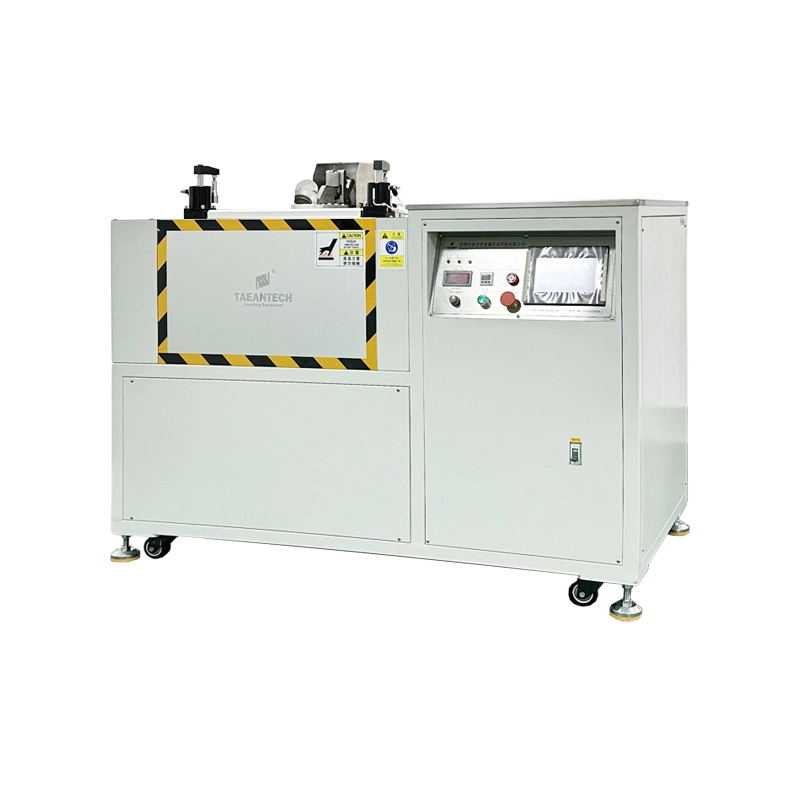
The TAKJ-AGV series is a multi-specification vacuum automatic ingot casting machine for precious metal bar production. The casting room completes melting and casting under vacuum protection, while the pneumatic lid, graphite mold, PID temperature control, and Mitsubishi PLC interface help operators manage repeatable bar casting with fewer manual steps.
| Product Name | TAEANTECH 4 kg, 8 kg, 30 kg Gold Bar Making Machine |
|---|---|
| Product Type | Automatic vacuum gold bar casting machine |
| Published Models | AGV4, AGV8, AGV12.5 |
| Power Supply | Three-phase five-wire 380V, 50/60Hz |
| Power | 60 kW |
| Meltable Metals | Gold, silver, copper |
| Maximum Capacity | 4 kg gold, 8 kg gold, or 12.5 kg gold by model |
| Published Casting Products | 4 pieces x 1 kg, 8 pieces x 1 kg, 1 piece x 12.5 kg; product page also references 30 kg bars |
| Beat Time | 10-12 minutes in the specification table; 6-12 minutes also shown in product summary |
| Maximum Temperature | 1550 C in the specification table; 1500 C also shown in product summary |
| Control System | Mitsubishi PLC plus human-machine interface intelligent control system |
| Operation Mode | One-click operation process with Poka Yoke anti-error system |
| Vacuum | -98 Kpa |
| Inert Gas | Nitrogen or argon |
| Cooling System | Water cooling |
| Dimensions | 1530 x 800 x 1060 mm |
| Weight | 480 kg |
These Taeantech articles support buyer education on vacuum bar casting, mining-scale production, and jewelry manufacturing equipment selection.
This article focuses on how vacuum gold bar casting equipment supports industrial precious metal processing, with attention to controlled atmosphere, casting consistency, and production planning.
Read ArticleMining and refinery buyers can use this topic to review large-batch bar casting needs, equipment efficiency, repeatable operation, and the practical value of automated vacuum casting.
Read ArticleJewelry manufacturing teams can use this article to compare machine capacity, casting quality, process control, and supplier communication before selecting vacuum bar casting equipment.
Read ArticleThe feedback below reflects realistic sourcing concerns for precious metal casting equipment buyers reviewing capacity, documentation, and production fit.
We needed a supplier discussion around 1 kg and 12.5 kg bar output, vacuum level, mold changeover, and utility conditions. The AGV specification gave our engineering and purchasing teams a clear base for quotation comparison.
Our review focused on vacuum protection, PLC operation, cooling water layout, and safety alarms for repeated gold and silver batches. The model table made it easier to define what our workshop needed before equipment approval.
We compared the equipment for bullion preparation and internal precious metal recycling. The key value for our team was the controlled casting room, repeatable temperature management, and the ability to discuss graphite mold requirements.
Use these questions to prepare technical communication before selecting a vacuum gold bar casting machine model.
The published TAKJ-AGV configuration supports common bullion formats such as 4 pieces of 1 kg, 8 pieces of 1 kg, 1 piece of 12.5 kg, and 1 piece of 30 kg, depending on the selected model and mold set. Buyers should confirm the target bar weight, mold engraving needs, cooling plan, and expected batch volume before final model selection.
Vacuum protection reduces contact between molten precious metal and air during melting and solidification. For procurement teams, this matters because oxidation, gas inclusion, surface ripple, and pore risk can affect bar appearance and repeatability. Taeantech lists vacuum pressure up to -98 Kpa with nitrogen or argon support for the AGV series.
A practical inquiry should include target bar weights, daily or shift output, metal type, available power supply, cooling water conditions, workshop floor space, preferred mold quantity, logo or marking requirements, local safety review needs, and any receiving or packing standards. These details help the supplier match machine capacity and accessory requirements.
The control system should be reviewed around operator workflow, temperature setting range, process repeatability, alarm handling, interface language needs, and parameter access. The product page states Mitsubishi PLC control with an intelligent human-machine interface and PID temperature control, so buyers can ask for operation video, control panel photos, and sample casting records.
The published specification lists gold, silver, and copper as meltable metals. In real procurement review, the buyer should still separate metal recipes, crucible planning, mold compatibility, cleaning workflow, and temperature settings because different metals can require different process handling and contamination controls.
Buyers should check three-phase 380V 50/60Hz power availability, water cooling access, compressed air for the pneumatic lid, exhaust and workshop ventilation planning, equipment footprint, lifting access, operator clearance, and receiving route. These checks make it easier to prepare a realistic purchase request and avoid delays during site readiness review.


